Sunday, February 11, 2007

Is this what a run-up to War looks like?


Today, the United States claimed that Iranian supplied roadside bombs were responsible for 170 US troops deaths since 2004. It seems that the United States government is slowly prepping the American public to begin blaming Iran for Iraq's troubles. Instead of taking responsibility, President Bush seems to be finding evidence of Iranian involvement in the anti-U.S. insurgency.

While Iran is not a necessarily a good neighbor, these claims have not been verified by an independent source, states BBC News. To avoid another mess and War, the United States needs to begin multi-lateral talks. Even if Iran balks, then at least the U.S. government can say they tried to talk. Instead, the United States government wants to push unverifiable evidence to find any reason to depose of the Iranian leader, Mahmoud Ahmadinejad.

Hopefully, the American press and public have learned to be leery of American intelligence reports and not jump the gun on War. Now is the time to question and stand up to the people we have elected. If Iran truly is a threat to world peace then it is up to the United States and other nations to come to an agreement without beginning another Middle East conquest.

Friday, February 9, 2007

Barack Embraces Netroots


Today Barack Obama made an announcement from his website, via video link, that he is going to be making an important speech tomorrow from Springfield, Illinois, the state capital. In this video announcement he mentioned how he would create a hub for netroots campaigners to interact with each other and organize through his website.

This strategy is what propelled Howard Dean to the forefront of the 2004 Democratic primaries until "The Scream" was broadcast into the homes all across America

Sunday, February 4, 2007

Above the Fray


I have avoided preaching on this blog until now, but I feel that since Monday will be a day that is inundated with debate over Senate resolutions on the War in Iraq, today was my day to get on The Mount.

Partisanship will kill this nation. We are all allowed to have our own political opinions. I have my own and so does everyone I know, however, our legislators and executives, while they are bred to be partisan, should learn to compromise more efficiently. Every Sunday morning, many of our legislators and prognosticators pull out their soap boxes and start attacking the opposing party.

What does this accomplish? Pointing out the other sides weakness is key to winning votes, but it is not key to solving critical issues saving this country. An example of this is Bill Kristol's editorial in the Weekly Standard today. In his article he says

"John Warner of Virginia, Gordon Smith of Oregon, and Susan Collins and Olympia Snowe of Maine are the four Republican senators (in addition to Nebraska's Chuck Hagel) currently signed on to the Democrats' anti-surge, anti-Petraeus, anti-troops, and anti-victory resolution."


We have to ask Bill Kristol what exactly he is trying to accomplish by publishing such venomous words, because if it is unity in the face of "the terrorists" then he is acting in discord. It is this kind of language that divides.

If this country is to succeed through the War on Terror and into the future as a global player, then we have to try and stay above the fray of partisanship. Although America as an "empire" will most likely be eclipsed by China in 25 years as the new superpower, the nation will cede power much like Britain did to America in the early 20th Century. To maintain a working government and a civil electorate, we have to compromise and learn not be consumed by our own human nature. It was Henry Clay, "The Great Compromiser" who said, "“Let him who elevates himself above humanity . . . say, if he pleases, 'I will never compromise'; but let no one who is not above the frailties of our common nature disdain compromise.”

Tuesday, January 30, 2007

Signs of Life from new Senate


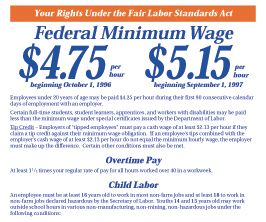
Today, the Senate voted in an 87-10 margin to increase the minimum wage. Although, the vote was barred from debate for 30 hours and has the possibility of being held up another 30 hours if Senate Republicans want to continue discussion over the issue. This version of the bill is different from the one originally sent to the Senate floor from the House of Representatives. The original was voted down due to the fact that there was not enough protection for small businesses. The new bill includes an 8 billion dollar tax break and "regulatory concessions" for the protection of these above mentioned businesses.

The bill only has two more steps until it becomes law, and one of those is going back to the House for approval of changes, the other being that it needs to be signed by the President, who has publicly supported a minimum wage increase, so long as small business is catered to. However, Charles Rangel (D-NY), chairman of the House Ways and Means Committee, does not support this bill coming from the Senate mainly because of the fact that tax and money issues are supposed to be decided in the House, per the Constitution.

On a side note, the minimum wage has not been raised since 1997, one year before President Clinton was to be impeached, 3 years before Y2K, and 4 years before the September 11th terrorist attacks.

Regardless of what happens, the Democrats need to maintain unity, even between the House and the Senate, if they want to uphold and further their own power. If they come to in-fighting, they will most likely face the same fate as the Republican-led Congress that was deposed in the 2006 Midterms.

Friday, January 26, 2007

Congress vs. The President: Nothing New

In a recent article in the New York Times, the issue of Congressional powers and their limits was raised again.
Since there is a war going on, and as public opinion plummets on the current policy, the debate about what role the Congress and Executive truly heats up. However, this is nothing new. History has shown that there has been an almost incessant battle between the two branches; a sibling rivalry and sometimes inferiority complexes (see impeachment of Andrew Johnson).


This power relationship is one of the most important in American politics, in that, if it fails, so does our entire system of government. Maintaining this balance of power, and not allowing either the Congress or Executive to shun the Constitution, is essential to a free nation.

Lastly, in an article in USA Today, author Ross Baker reviews a little bit of the history of Congressional oversight. He lays out the importance of Congress being moderate in their power relationship with The President and also cautions the 110th Congress to not get too far ahead of itself.

Either way, the Congress and President have a very tenuous relationship, but this is nothing new. Throughout American history they've each fought hard for their own powers and they will continute to do so, as long as the institution of American government exists.